Macduff’s Misery — What can we learn from it?

In Act IV of Macbeth, Macduff receives the worst news that any parent can ever receive:  his children and his wife have been killed.  Hearing this news surely motivates Macduff to kill Macbeth, the dictator, but I think that this scene provides much more than a motivation for Macduff.  The very human and very sad reaction by Macduff.

One thing Macduff says is, “He had no children.”  Now that I have children of my own, I understand and feel Macduff’s greif much more than I did when I was younger.  The truly sad thing about this scene is that it reminds me of the different news items I hear every day where good people are killed — and fathers and mothers are left without their children.  When Ross breaks this horrible news to Macduff, he also says that everyone should share his suffering.  “No mind that’s honest,” he says, can avoid suffering along with Macduff’s family: 

“No mind that’s honest

but in it shares some woe.”

I think that Ross is right:  Human beings should feel it when bad things happen to good people, even when we don’t know those people  For this reason, I’m moved when I hear stories of people making connections and caring when strangers have to suffer.  A recent example of this happened right after the earthquake, tsunami, and subsequent nuclear accident wiped out cities in Japan.  A colleague told me that a third grade class, which had been writing a blog, had received a comment from someone in Japan.  Their teacher was surprised to see that the students were distraught — some even in tears — when they came to class after learning about the Tsunami:

“Where did it hit?”

“Is our friend OK?”

The lesson I take away from this story:  When we share our humanity and connect with people — even in very small ways — we become more human.  Even though there is pain involved, I think that our lives are much richer when we make some kind of connection to people around the world.  I also hope that we can connect over joyful news as well as the very sad.
Posted in Uncategorized | Leave a comment

Text and Subtext in Act I Scene 5

In this scene Macbeth’s wife talks to him.  She has read his letter, telling her about the good news that he heard from the witches, and she wants to make sure that he acts quickly in order to become king.

It’s hard to know exactly how Macbeth feels about the news, however.  In scene 3, he has several different asides that vary in emotion from elation (“The greatest is behind”) to horror (“let light not see my black and deep desires”).  I’m not sure of what Macbeth wants to do at this point, but my sense is that he has very strong reservations against killing his King. 

The question, then, is what he wants from Lady Macbeth:  Did he send the letter in hopes that SHE would get excited about becoming queen and talk him into committing the murder that he is afraid to commit?  Or did he send it innocently?  Does he really want to be pushed into action, or does he already know what he wants to do?

In the following passage, I am inventing a subtext for Macbeth that suggests that he can’t stand his wife, and just wants to go on living as he is (perhaps without having his crazy, nagging wife around).  This interpretation is unlikely, but I hope will get a few (cheap) laughs.  Enjoy:

Great Glamis! worthy Cawdor!
Greater than both, by the all-hail hereafter!

Thy letters have transported me beyond
This ignorant present, and I feel now
The future in the instant.

MACBETH

Oh God, why did I send that stupid letter?!  Now I have to deal with my wife nagging me about killing Duncan!  Ugh.

My dearest love,
Duncan comes here to-night.

WHAT?  Why did I just say that?  Now she’s going to bug me even more.  When will I learn?!

LADY MACBETH

And when goes hence?

MACBETH

To-morrow, as he purposes.

Great.  Here it comes… she’s going to start talking about murder.

LADY MACBETH

O, never
Shall sun that morrow see!

See… I knew it.

Your face, my thane, is as a book where men
May read strange matters. To beguile the time,
Look like the time; bear welcome in your eye,
Your hand, your tongue: look like the innocent flower,
But be the serpent under’t. He that’s coming
Must be provided for: and you shall put
This night’s great business into my dispatch;
Which shall to all our nights and days to come
Give solely sovereign sway and masterdom.

MACBETH

I knew it!!!  What can I say to get this crazy wife off of my back? 

We will speak further.

LADY MACBETH

Only look up clear;
To alter favour ever is to fear:
Leave all the rest to me.

Yeah, whatever… I’m never getting out of this.  At least I didn’t tell her that I’d clean out the moat…

Posted in English IV Class | 2 Comments

Macbeth’s Ambition — and what we might learn from it.

Over the past twenty years or so, I’ve thought a lot about… well, myself.  Sometimes, as I think about the man in the mirror, I consider this question:  What are my ambitions?  To what extent am I willing to work for them?  Do I want too much — or do I expect too little from myself?

Macbeth wants to be King (as anyone in his position would) but he allows this desire to get in the way of his true success.  He is a great warrior, recognized for valor in battle.  Why not stick with that and wait for the next thing?  Would he be un-ambitious — or lazy — if he did?  Perhaps making honest opportunity happen, rather than taking a shortcut is his real downfall.

When I consider my own definition, and my own job, I think that that “ambitious” is probably the wrong word to describe good teachers.  In my experience, “ambitious” teachers want to get nominated for teacher of the year, or want to become administrators, or they want to publish books about teaching.  The ones who have been my greatest mentors, however, have not been interested in any of these things.  When I think of “ambitious” teachers, I think of self-promotors.  The most inspirational teachers to me, however, have been teachers who focus on one thing:  teaching.  I suppose that one could say that their focus on teaching is ambitious — aspiring to be a great teacher.  But most of the connotations that I see when I look at Dictionary.com have to do with aspiring to be “something more.”  The definition I refer to cites the word’s origin as coming from a word used in the 1300’s that meant “going around to canvass for office.”  

I think that the world needs ambitious people.  If nobody wanted to be president, for example, we might have a problem of leadership.  On the other hand, however, I think that the ambitions for wealth or power or creating some kind of a name or legacy can actually get in the way of true achievement.  If I worry about publishing my next book, or about getting recognized and promoted into my next position, can I really do justice to the job that I’m doing right now?  I also suspect that the more that people are influenced by the symbols or signs of success and achievement, the more easily one can be deceived by the appearances of success, rather than authentic success.  So perhaps the question that I still have is about ambition itself:  Does it get in the way of achievement, or does it drive achievement?  Or does it do both at once?

Posted in English IV Class | Leave a comment

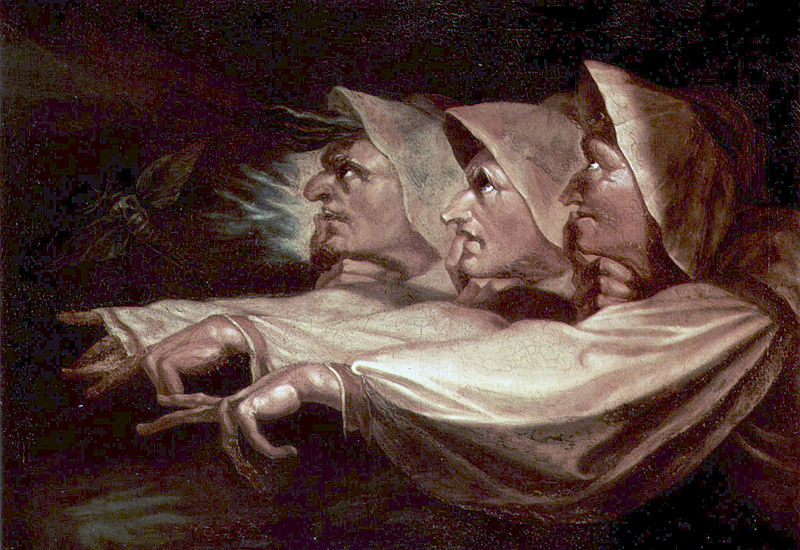
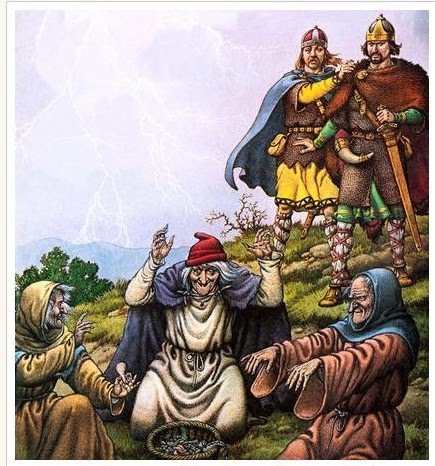
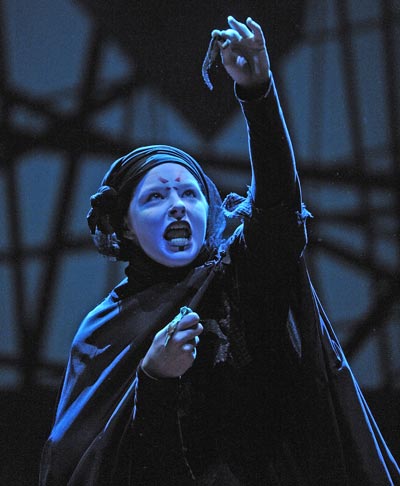
Three Witches — Some images and an article.

Three Witches – eNotes.com Reference.

I noticed a couple of things as I tried to do the blog post I assigned to students on images of characters.

  1. It was very hard for me to think of anything to do besides going to Google Images and looking for “Macbeth,” or “Macbeth King” or the name of some other character.
  2. When I searched for images in this way, I inevitably found multiple images, but most of them were un-cited.  So then a moral dilemma comes up:  Do I post these images, which I don’t know how to cite, or do I ignore the rules and post them like everyone else has?  There’s one thing for certain:  I can’t draw.
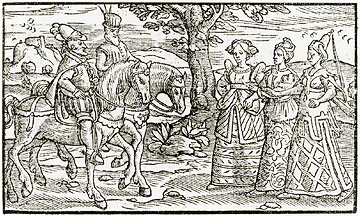
It has been interesting, however, to look at the many different ways that the witches have been portrayed in different productions.  The article that I found above (which was really just a link to a Wikipedia article, gives a wonderful history and tradition of the different ways that the witches have been portrayed.  Here are some more examples that  I found:
 
Posted in English IV Class | Leave a comment

Why am I making everyone do blogs?

Why literature?  Why blogs? 

I’ll start at the first question.  I love literature.  I loved it when I was in middle school — so much that I decided that I wanted to be an English teacher for the rest of my life.  So, more than thirty five years later, all I’ve ever done to earn a living is teach literature.  Why do I think it’s worth doing?

My hope is that by reading literature and sharing thoughts about it, students’ lives will become richer — as mine has.  And I think that blogs might be a natural way for students to share their thoughts about literature and to find other people’s thoughts on the literature.  I also hope that students develop some skills for writing blogs and sharing ideas — for finding good things related to this course, which can be applied to other thi ngs that they really want to learn about.  I read a really interesting article in Sunday’s New York Times that talked about how a community that has adopted a “21st century classroom” has not seen scores improve.   The article also includes some interesting graphics about school spending and some audio from people who are interested in what the future of education looks like.  I guess this article serves as a warning to me that students should be writing for a purpose — and that I need to make sure that all of the assignments have a purpose, rather than having assignments that are ends in themselves.

Posted in What Schools Ought to Teach | Leave a comment

The beginning of Academic Year 2011-12

It’s a new year, full of new possibilities for education.  At the moment, the thing that has me inspired — and very nervous — is the enormous change that has happened in the world of education since I started teaching (almost 20 years ago). 

This change is the availability of information and collaboration tools.  There is an enormous spiderweb of ideas and thoughts available to me and to educators worldwide — and this year, I’m going to explore this spiderweb.  To my students:  I hope that the experience of building and maintaining your blogs makes the educational experience of my class more worthwhile than it would be otherwise.  I also hope that our class wiki becomes a source of interesting and valuable insights that are produced by the class.  At the moment, I’m very eager to see how these different tools work for us as a community, and I hope that you all enjoy the ride.

Posted in Uncategorized | Leave a comment